

How To Clean Limescale Out Of A Plate Exchanger Water Heater
Tabular array of Contents
- Where Does Scale Come From?
- How Is Scale Controlled?
- How Do I Know if Cleaning is Necessary?
- Which Product Should I Use for Cleaning?
- How to Clean a Heat Exchanger
- Contact Us
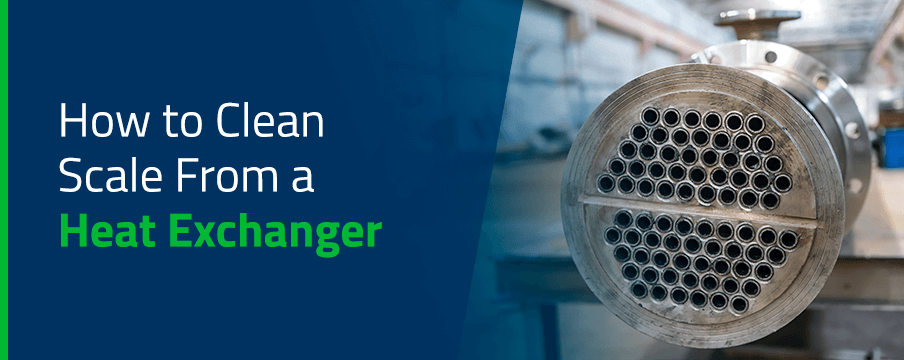
Scale is an unwanted material that accumulates onto the internal surfaces of a heat exchanger — this deposition is otherwise known as fouling. If untreated, fouling volition harden and forestall the system from operating at its intended, energy-efficient state.
Scaling and fouling will increase the system's resistance to heat transfer, which is undesirable for water heating and cooling equipment. Even sparse layers of scale will create effective insulation since the percentage of energy required to oestrus or cool the water increases every bit calibration buildup does.
Periodic heat exchanger cleanings are essential because scale formation can apace consequence in overheating, tube failures, increased energy consumption and a ascent in operational costs. Calibration may even corrode equipment if left without proper care, requiring intensive repairs or total replacement to correct.
Learn How We Can Assistance
Where Does the Scale Come up From in a Heat Exchanger?
Scale comes in a variety of forms, just the most common is calcium carbonate or CaCO3. Calcium calibration precipitates when the threshold solubility of calcium and carbonate is exceeded. Scale occurs when the dissolved minerals found in a h2o source fall out of suspension and form a continuous deposit layer on the surface of a rut exchanger.
Calcium, magnesium and silica are common minerals found in water supplies, so they are typical components of scale. Hard water is a master source of this type of calibration. The hardness of a water source is generally expressed every bit having a college amount of dissolved minerals — hardness is usually measured in parts per million (PPM).
Calcium and alkalinity exist in different concentrations in about all make-up sources. As evaporation removes pure water from the cooling tower, the dissolved solids remaining increase in concentration. If the concentration becomes likewise keen, they combine to form calcium carbonate calibration.
Scale buildup on walls, tubes and other heating and cooling equipment surfaces is more likely in hard water. Scaling problems tend to accumulate faster when there is a loftier mineral content in the h2o. Other particulates that may add together to the overall scale composition include lime and rust deposits, though calcium and magnesium are the most prevalent.
Related Case Studies
How Is Calibration Usually Controlled in a Rut Exchanger?
Preventing calibration formation is a combination of controlling cycles of concentration and modifying the solubility of calcium carbonate with chemical threshold inhibitors or other ways. By knowing the threshold solubility, or the concentration at which calibration begins to grade, we tin control the weather at a condom margin below this bespeak.
The most effective way to mitigate calibration buildup is to prevent its germination in the commencement identify. Calibration can be controlled in a rut exchanger by:
- Pretreating banality make-up water: Demineralizers, water softeners and reverse osmosis can target and remove minerals that are probable to form scale.
- Establishing an ongoing water treatment program: Perform regular preventative maintenance to the estrus exchanger and schedule periodic chemic cleaning of any water cooling or heating equipment.
- Reducing the mineral content in water sources: Brand the water "softer" and slow calibration germination with various solutions, including chemical softening, membrane separation softening and cation exchange softening.
If scale has already formed in a oestrus exchanger, you can restore the arrangement to an energy-efficient country past cleaning scale buildup and establishing measures for future prevention.
How Do I Know if Cleaning the Rut Exchanger Is Necessary?
A heat exchanger lets rut menstruation through material, such as a stainless steel plate or copper tube. The heat moves from the hot side to the absurd side. Scale and other accumulating materials insulate the heat commutation'south surface and reduce its efficiency.
Most heat exchangers are designed to operate at a specific temperature range chosen ΔT(Delta T). ΔT describes the difference between the temperature going into and coming out of the heat exchanger. A reduction in ΔT is an indication of a reduction in oestrus transfer efficiency. Thisdecrease is typically due to scale formation, microbiological fouling or mud settling in or on the tubes. It is more than likely for minerals to autumn out of suspension at higher water temperatures and settle into calibration deposits on a heat exchanger's interior surface.
For early on detection of scale buildup, we recommend keeping a daily operational log for every slice of equipment.
Monitor the system's heating and cooling functioning for efficiency indicators and place functional abnormalities before they become significant hazards.
Which Product Should I Use for Cleaning a Heat Exchanger?
Scalzo is the most effective product for descaling heat exchangers. While some exchangers may require unique products, Scalzo works on many systems. Scalzo contains hydrochloric acrid for efficient cleaning, while corrosion inhibitors and dispersants ensure the metal is protected and post-cleaning fouling does not occur.
Muriatic acid is not recommended for some materials — stainless steel in item. CA-100 should be used for oestrus exchangers with stainless steel components. The citric acid is less ambitious and will non pit stainless steel.
Ensure the chosen product will completely dissolve the scale past performing a preliminary examination on a sample of the deposit. This exam can verify the scale composition and may help you preclude futurity formations, too.
Get Scale Prevention Chemicals
What Is the Step-By-Step Procedure for Cleaning a Heat Exchanger?
Follow these steps for effective tank cleaning.
- Isolate the chiller by endmost valves as close to the unit as possible. Online cleanings are never equally effective as offline cleanings because the acid requires plenty contact time to dissolve the scale.
- Guess the total number of gallons of water in the rut exchanger and the isolated section of pipe. A plate-frame heat exchanger will be most 40% tower water, while vanquish and tube heat exchangers are about thirty% tower h2o. Ensure the cleaning solution tank is at least double the heat exchanger'south volume.
- Set the chemic feed pump to ensure the unit of measurement is full of cleaning solution. The return line that leads to the cleaning solution tank needs to come off the top of the heat exchanger. The above diagram can help you achieve an platonic setup.
- Add water to the cleaning solution tank and plow on the circulation pump. Operate the pump and keep adding h2o until it comes out of the return line back into the cleaning solution tank.
- With the circulation pump running, add 8 ounces of CTA-800 or an alternate anti-foam directly into the cleaning solution tank.
- At present add one gallon of Scalzo, Ox-Sol, CA-100 or the cleaning product recommended by your Chardon representative to the cleaning solution tank.
- Mensurate the pH of the solution by dipping a pH paper into the stream of water returning from the rut exchanger. The pH should exist two-3. If the pH does not subtract into this range, continue adding acrid until the returning pH is in the ii-three range.
- Go along circulating the cleaning solution. Check the pH every five minutes. Add boosted acid if the pH increases to greater than three.
- Repeat step 8 until the pH remains between 2 and three for 30 minutes. The heat exchanger is now clean. Neutralize the cleaning solution to a pH of 5 with BD-six past adding it to the tank and circulating the mixture.
- Drain the tank and heat exchanger to a germ-free sewer.
- Add fresh water to the tank and broadcast the fresh water until a pH of 6 or 7 is reached and maintained.
- Add 1/two gallon of Tube Bright for terminal-rinse to passivate raw metal surfaces. Circulate for 15 minutes and drain or exit chemicals in the system if it's to be put online.
- If required, remove end bells and inspect tube sheets, tubes and end bells to determine the desired cleaning. If debris remains, manually remove debris and flush areas with treating water.
If the system is even so not satisfactorily cleaned, replace the stop bells and repeat the procedure 1-10 once again.
At Chardon Labs, nosotros're an industrial and commercial water treatment company dedicated to quality customer service. Our treatment programs preclude calibration and corrosion from fouling your heat exchanger, saving you time, coin and hassle. If you need to restore whatever piece of h2o heating or cooling equipment to an energy-efficient state, contact Chardon Laboratories for your scale prevention needs.

Source: https://www.chardonlabs.com/resources/how-to-clean-scale-from-a-heat-exchanger/
Posted by: chmielewskinothead1991.blogspot.com
0 Response to "How To Clean Limescale Out Of A Plate Exchanger Water Heater"
Post a Comment